Wartime retreat
Young Captain Jack · The Son of a SoldierWartime retreat is not merely a sign of battlefield reversal in the story; it is the condition through which military defeat spills into homes, hospitals, shops, and roads. Retreating soldiers bring exhaustion, wounds, dust, artillery fire, and uncertainty to Oldville and the Ruthven plantation, forcing civilians to decide what duties survive when ordinary authority has been shaken. The retreats expose a sharp ethical contrast between soldiers who recognize private property and wounded men’s protection and guerrillas who follow armies for the sake of looting. They also drive the plot toward Jack Ruthven’s imprisonment, the recovery of the black tin box from the Nautilus wreck, and the eventual restoration of Colonel Stanton’s fortune.
Definition and Wartime Setting
Wartime retreat appears first as a change in the military balance around Oldville. The army of the North has steadily pressed the army of the South backward until the Confederate camp lies less than four miles from Jack Ruthven’s home. For two days, cannon fire can be heard distinctly, and the women of the district fear that advancing troops will descend upon their homes and plunder them. Retreat therefore changes the plantation’s meaning: it is no longer simply a family residence but a vulnerable point on the route of armies.
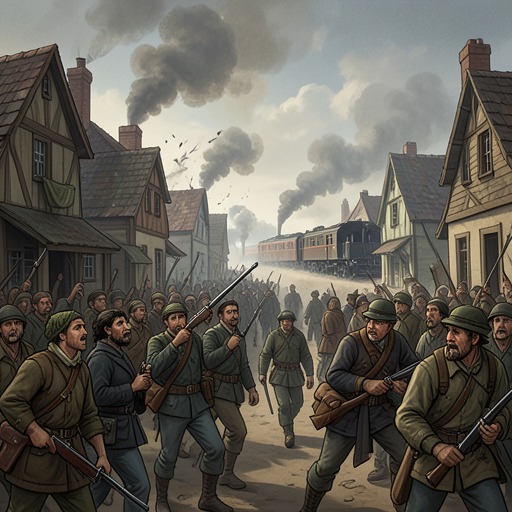
The retreating forces are presented through their physical condition. Soldiers pass the plantation on foot and horseback, exhausted, ragged, and covered with dust and dirt; many are badly wounded. Small-arms fire has ceased, but distant cannon continues to boom and shells occasionally burst nearby. The movement of an army in retreat is thus both organized and visibly broken down, carrying the material consequences of battle through a civilian landscape rather than leaving violence at a remote front.
Retreat also produces confusion about who controls the surrounding roads. When Jack sees Confederate soldiers moving through the woods, he recognizes that they are falling back toward the plantation. Marion Ruthven confirms that the soldiers are suffering another defeat and fears that they will reach the family home. The immediate danger is answered not with flight but with a decision to aid the wounded, turning military reversal into a test of civilian responsibility.
Retreat at the Ruthven Plantation
As the Confederates reach the plantation, Mrs. Ruthven orders that the wounded be brought inside. Servants prepare cots on the lower floor, and six wounded Confederates are placed in the sitting room under the care of a young surgeon. Mrs. Ruthven and Marion assist him. The mansion consequently becomes a field hospital while the army continues past it, its domestic rooms temporarily governed by medical need rather than family routine.
The retreat does not remove danger from the property. Jack looks down the roadway and warns that the enemy will arrive in less than ten minutes. A cavalry troop passes without molesting the homestead, but it is followed by a company of guerrillas led by Sandy Barnes. These men are described as followers of every army who fight chiefly to loot afterward. Their arrival turns the retreating column into a second threat: regular military movement is followed by irregular violence directed at civilian property.
Jack responds by drawing his command across the lawn. He insists that the house is private property and that it is now a hospital containing six wounded Confederates in a surgeon’s charge. The guerrillas question whether the boys will resist and threaten to enter anyway because the house appears worth visiting. Jack’s defense joins property protection to the protection of the wounded, making the plantation a moral boundary in the middle of a retreating war zone.
The distinction between disciplined military conduct and predatory opportunism becomes explicit when a colonel is asked whether the homestead will be harmed. He answers that an officer who is a gentleman respects private property and that Jack and the household have nothing to fear so long as they act without treachery. Jack notices the difference between this officer and the guerrilla who threatened him with a sword. The retreat therefore contains competing versions of military power: one claims limits and accountability, while the other treats defeat and displacement as opportunities for seizure.
Retreat Through Oldville
A later retreat spreads through Oldville itself. A horseman announces that the Federal troops are in retreat, and cannon fire erupts from the mountainside as Federal forces enter the town. The roads and the green soon fill with soldiers who have fought hard and are nearly exhausted. More troops follow, and a systematic northward withdrawal begins amid incessant musketry and the repeated booming of cannon.
The scene tempts Jack toward direct participation, but he recognizes that the Home Guard has no useful military role at that moment. If the boys opened fire, the Federal troops would annihilate them. Their restraint is therefore practical rather than passive: they protect themselves and avoid adding a futile civilian attack to a confused withdrawal. The town’s stores and buildings are not systematically plundered, although the church is struck by several cannonballs, and the fighting shifts toward the mountains and the Ruthven plantations.
Jack’s attention then turns toward St. John Ruthven’s property. He believes that he and Darcy Gilbert should go there to see that no damage is done. The impulse links local guardianship to the broader pattern of retreat: when armies move through the district, civilian protection becomes mobile, improvised, and dependent on people willing to follow the danger rather than remain safely at home.
Near Jack’s home, a Federal battery appears, drawn by horses covered with foam, followed by an infantry regiment. Jack identifies Colonel Stanton’s regiment and sees that it too is in retreat, with opposing soldiers pursuing it down the hill. He also sees Colonel Stanton on horseback and admires his bearing. The image places the colonel within the same exposed movement as the other soldiers, while foreshadowing the later revelation that his connection with Jack reaches back to the wreck and the family history hidden within it.
Retreat, Captivity, and Evidence
The disorder surrounding retreat allows Dr. Mackey to convert personal conflict into forced removal. After Jack calls him a fraud, Mackey threatens to make him suffer, seizes him by both arms, and orders Confederate soldiers to conduct him to camp and prevent his escape. Jack’s captivity is not a formal consequence of a clearly established military offense; it is an act of coercion carried out amid wartime authority and confusion. The retreating environment gives Mackey the armed assistance needed to suppress Jack when persuasion fails.
Jack and his companions spend two days in a cave under guerrilla control. The outlaws treat them brutally and provide barely enough food to prevent starvation. Pete Gendron is especially bitter toward Jack and repeatedly insults him, even saying that, if he were Dr. Mackey, he would kill Jack to obtain the money for himself. Retreat thus changes from a visible movement of armies into a condition of captivity, deprivation, and private criminal ambition.
The consequences of the guerrillas’ own defeat eventually reverse that danger. After Jack returns home, a long battle in the mountains between Federal troops and the guerrillas kills many of the outlaws, including those who held him prisoner; Gendron also dies without revealing what he knows about Dr. Mackey’s past. The destruction of the camp permits a thorough search, which uncovers stolen goods and other valuables, including the black tin box taken from the wreck of the Nautilus.
The recovered box is later handed to Colonel Stanton. Its papers are recognized as his precious documents, and Stanton tells Jack that nothing now stands between them and their fortune. The retreat has therefore produced a chain of reversals: Confederate withdrawal brings wounded men to the plantation; Federal withdrawal and guerrilla pursuit create danger; guerrilla defeat restores the stolen object; and the object’s return converts wartime disorder into the recovery of property and identity-bearing evidence.
Narrative and Ethical Significance
The story uses retreat to connect public conflict with private obligations. Cannon fire is heard from homes, armies pass through plantation roads, wounded soldiers occupy a sitting room, and a church is damaged by artillery. These details make war a social condition rather than a distant sequence of battles. A shop in Oldville is also left with scanty, shop-worn stock because the war has nearly ruined its trade, showing that military movement alters civilian commerce as well as physical safety.
Retreat repeatedly tests the difference between legitimate protection and predation. Jack defends the plantation without pretending that the Home Guard could defeat a regular army. Mrs. Ruthven and Marion protect wounded Confederates despite the danger of an approaching enemy. The colonel’s promise to respect private property offers a limited code within warfare, while the guerrillas’ stated purpose of looting rejects that code. Mackey’s seizure of Jack and the cave’s starvation conditions reveal how quickly the language of military necessity can conceal personal exploitation.
Finally, retreat functions as a narrative mechanism for disclosure. It brings Colonel Stanton’s regiment into Jack’s view, places the wounded colonel within reach of testimony about a shipwreck, and enables the stolen tin box to move from the Nautilus wreck into guerrilla hands and finally back to Stanton. The same military reversal that threatens the household also drives the hidden past toward recognition: the wreck, the unmarked clothing and handkerchief, the worn ring, Stanton’s fevered references to Laura and his son Jack, and the recovered papers converge as the war’s movement exposes what peacetime concealment had left unresolved.